
MediaCity celebrates delivery of groundbreaking virtual production acting as nerve-centre for BBC’s World Cup coverage
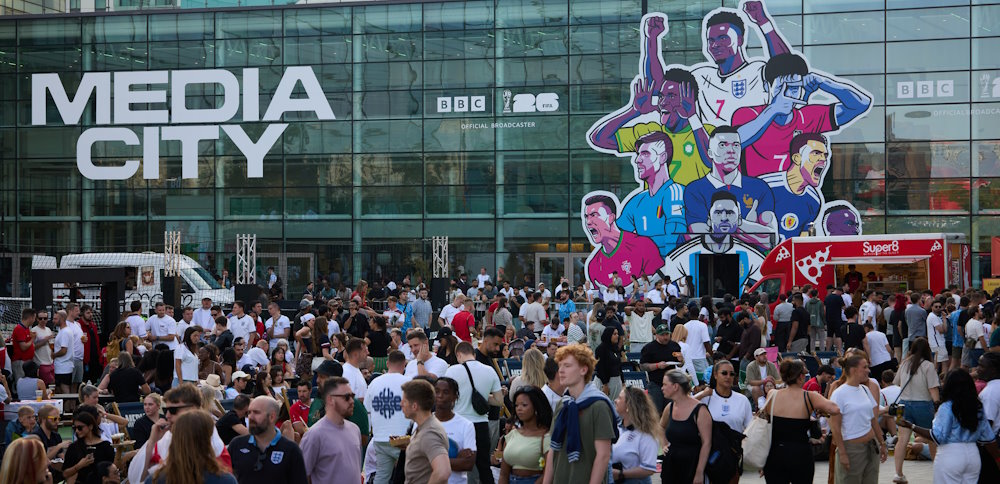
MediaCity has once again demonstrated its world-leading live broadcast capabilities, serving as the nerve centre for the BBC's World Cup coverage through its advanced virtual production technology, world-class studios and highly skilled production teams.
Over the course of the tournament, MediaCity Studios and Post delivered:
- Over 120 hours of live content produced from MediaCity Studios
- More than 325 days of editing across the 6 weeks of the tournament from MediaCity Post
- Over 1500 shifts have been delivered from the Studio block alone with many supporting digital content creators and back office teams
- Reach of 42.8 million on BBC TV and 237 million streams on BBC iPlayer and the BBC Sport website & app
- Thousands of visitors and community groups welcomed to the World Cup playground
- 154 hours of content produced from MediaCity’s pitch side Content Pavilion studio
Working in partnership with BBC Sport, the operation included four dedicated studio builds alongside additional spaces supporting highlight programming for BBC Sport, iPlayer and the BBC Sport app.
Alice Webb, CEO of MediaCity said:
MediaCity is built for moments like this. The BBC's World Cup coverage showcased the incredible expertise across MediaCity Studios and MediaCity Post, our people and our partnerships. Delivering world-class live productions is what we do every day, and it's fantastic to see that expertise brought together for one of the world's biggest sporting events.
Alex Kay-Jelski, BBC Director of Sport, said:
By basing our World Cup studio in Salford, we were able to take full advantage of the world-class technology, production facilities and exceptional teams based at MediaCity. This gave us the flexibility to serve all BBC Sport platforms seamlessly, enabling our pundits to move effortlessly from live TV coverage to BBC Radio 5 Live post-match analysis and digital content creation in our new content space.
The tournament saw MediaCity Studios deploy an advanced multiple tracked camera and LED virtual production environment, demonstrating the leading production capabilities MediaCity has always offered broadcasters and content creators.
At the heart of the production was a state-of-the-art LED volume, enabling presenters and pundits to appear as though they were broadcasting live from host cities across the tournament. The production featured 54 bespoke virtual environments that could be updated dynamically throughout the competition, changing from day to dusk and night depending on fixtures and live output.
Delivering this experience required significant technical innovation. Using Unreal Engine and Pixotope virtual production software for the first time, MediaCity Studios created highly realistic virtual environments precisely aligned with the physical studio space using LiDAR scanning and extensive camera calibration. Each broadcast camera underwent weeks of calibration to achieve sub-millimetre accuracy, seamlessly blending the physical and virtual worlds for viewers at home.
The project further expanded MediaCity Studios' virtual production capability, with specialist teams developing new workflows and building expertise in Unreal Engine and Pixotope. Alongside permanent staff and freelancers, this investment strengthened advanced production skills within the North West's creative and technical workforce.
Andy Waters, Head of Studios at MediaCity said:
The World Cup demonstrates the breadth of capability we've built at MediaCity Studios. Combining virtual production, live broadcasting and complex engineering is part of what our teams do, and this project brought those capabilities together at an exceptional scale. It's ultimately the expertise of our people and our partnership with the BBC that made it possible.
Managing a live production of this scale also required sophisticated engineering behind the scenes. Match feeds travelled from FIFA's International Broadcast Centre in Dallas via transatlantic fibre networks before being processed at MediaCity, where dozens of HDR feeds, augmented reality graphics, virtual environments and live studio output were synchronised in real time. Automated disaster recovery systems ensured uninterrupted broadcasting throughout the tournament, with failover systems designed to switch instantly should any element of the production encounter an issue.
The operation also expanded MediaCity Post’s production capability, with more than 40 edit suites supporting BBC Sport's tournament output, alongside the ability to remotely access replay systems in Dallas to enhance live analysis.
The BBC's World Cup coverage is the latest example of MediaCity bringing together world-class studios, advanced production technology and specialist expertise to deliver complex live broadcasts from Greater Manchester to audiences around the world.
While much of the magic of live television happens behind studio walls, MediaCity opened the World Cup up to the public through its biggest ever Festival of Football. Throughout the tournament, local communities, visitors and football fans were invited to experience the excitement surrounding the BBC's coverage first-hand, transforming the campus into a destination where audiences could feel part of one of the world's biggest sporting events.
From an iconic five-a-side pitch and live match screenings to creator takeovers, gaming experiences and a dedicated Content Pavilion showcasing the next generation of storytellers, MediaCity brought together broadcast, sport and community in a way that only a thriving creative campus can.